Guides / How to write a family memoir
How to write a family memoir
A step by step way to turn a life into a book your family will keep, from the first gathered story to the finished page, without needing to be a writer.
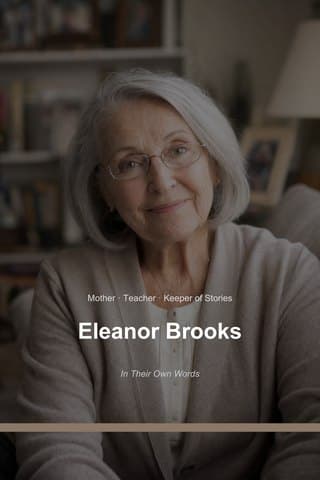
A family memoir is not a biography. Nobody is waiting for the definitive account of your grandmother's life, with dates checked and everything in order. What your family will treasure is something smaller and warmer: her voice on the page, the stories she told, the way she saw her own life. That is a far more forgiving thing to make than a proper book, and this guide walks you through it one step at a time.
You do not need to be a writer. You need to be a good listener, a patient collector, and someone willing to keep a life from being forgotten. The rest is craft you can learn as you go.
Take the questions with you
Enter your name and email and we will send you the printable keepsake: the ten most important questions in a beautiful format you can print and keep.
The steps, in order
Step 1: Gather before you write
The most common mistake is starting with a blank document. Do not write yet. Collect first, ideally in the person's own voice. Record conversations, dig out letters and photographs, note the stories that already get told at every gathering. Our guide to how to record your parents' life story walks through the gathering, and a set of life story prompts keeps the conversation moving. A memoir is built from raw material, and you cannot shape what you have not gathered. This stage matters most and is the one people rush.
Step 2: Find the thread
Once you have a pile of stories, look for what holds them together. It rarely has to be a strict timeline. It might be a place the family kept returning to, a trade passed down, a quality that shows up in every decade. The thread is what turns a heap of anecdotes into a book with a shape, and it usually reveals itself only once the gathering is done.
Step 3: Choose a structure
With a thread in hand, pick a simple structure. Chronological is the obvious choice and works well. So does organising by theme, childhood, love, work, the years of raising a family, so that each chapter can stand on its own. You can also build the whole book around a handful of turning points and let everything gather around them. Choose the one that fits the stories you actually have.
Step 4: Write in their voice, not yours
Here is the secret that makes family memoirs sing: keep the subject's own words. Where you have a recording, use their phrasing, their turns of speech, the way they open a story. Your job is often to arrange and connect rather than to compose from scratch. A memoir written in the author's polished prose loses the very thing the family wanted, the sound of the person.
Step 5: Write one chapter, not the whole book
Do not try to draft the memoir in one heroic push. Take a single story you love and write that, start to finish. One good chapter teaches you the tone, shows the project is real, and gives you something to show the family, which almost always brings more memories out of the woodwork. Momentum comes from finishing something small, not from planning something large.
Step 6: Bring in photographs and keepsakes
A memoir is not only words. A photograph on the facing page, a scanned letter, a recipe in the original handwriting, these turn a manuscript into an heirloom. Caption them with more than names and dates: a line about who took the photo, or what happened just after it, so the image carries a story too.
Step 7: Share it while it can be enjoyed
Do not wait for perfect. Print a first version, or share the draft, while the person and the family can still read it together. A memoir read aloud at a birthday, corrected and added to around the table, becomes a living thing. You can always refine it later. The worst outcome is a perfect book nobody saw in time.
What your family will treasure is not a biography. It is her voice on the page.
The hard part, and how to get past it
For almost everyone, the wall is not the writing. It is the gathering, sitting down again and again to draw the stories out, capture them, and keep them somewhere safe before they fade. That is slow, it is easy to postpone, and it is the reason so many family memoirs stay an intention rather than a book. If you can solve the gathering, the writing becomes a pleasure rather than a mountain.
Let the gathering happen on its own
This is exactly why we built HeartTold. One of our friendly, patient agents calls your parent or grandparent each week, at a time that suits them, and draws out their stories with warm questions. Every answer is kept in their own voice, in one private family archive that grows a little each week, so by the time you sit down to write, the raw material is already there, in their words, ready to shape into the memoir. There is no app for them to learn, just a phone call they look forward to. Everything is private, and never used to train AI models. You can see how it works in a short demo, or give HeartTold as a gift to the person whose story you want to keep.
Related guides: life story prompts, how to record your parents' life story, and questions to ask your grandparents.
Keep their stories, in their own voice
HeartTold turns a weekly phone call into a living family memory vault: their voice, their memories, their photos, kept for the people who love them.
Common questions
How do I start writing a family memoir?
Start by gathering, not writing. Collect the stories first, ideally in the person's own voice, through recorded conversations. Once you have the raw material, the shape of the book becomes far easier to see. A blank page is frightening; a folder full of real memories is an invitation.
How long should a family memoir be?
As long as the stories deserve and no longer. A moving family memoir can be forty pages or three hundred. Do not pad it to feel like a proper book, and do not cut a good story to hit a length. Let the life set the size.
What if I am not a writer?
Most people who write a beautiful family memoir are not writers, and it does not matter. The voice that carries a family memoir is the subject's own, so the most important skill is listening well and keeping their words. HeartTold gathers those words for you: one of our friendly, patient agents calls each week, so the raw material is already there when you sit down.
Our Call Agents are trained AI models, and we have been using them with our own families. Friendly, patient, and private: your family's stories are never used to train other AI models.